How Cash Flow Planning Works
You don’t need to know what will happen tomorrow to know how much money you are likely to have tomorrow. Cash Flow Planner helps you plan your future cash flow — before the money moves. Instead of staring at what you spent yesterday, you see what your balance may look like next week, next month, or next December.
What you actually do in the app
Eight short steps, and the forecast is yours. Nothing to install, no bank connection, no sign-up needed to try it.
Add your accounts
One account for every place your money really sits: card, cash, savings.
Enter your current balances
How much is on each account today — that is where the forecast starts.
Add income and expenses
Salary, rent, subscriptions, taxes: everything you already expect, with its date.
Mark what repeats
Set a transaction as recurring once and it is carried forward month after month.
Read your future daily balances
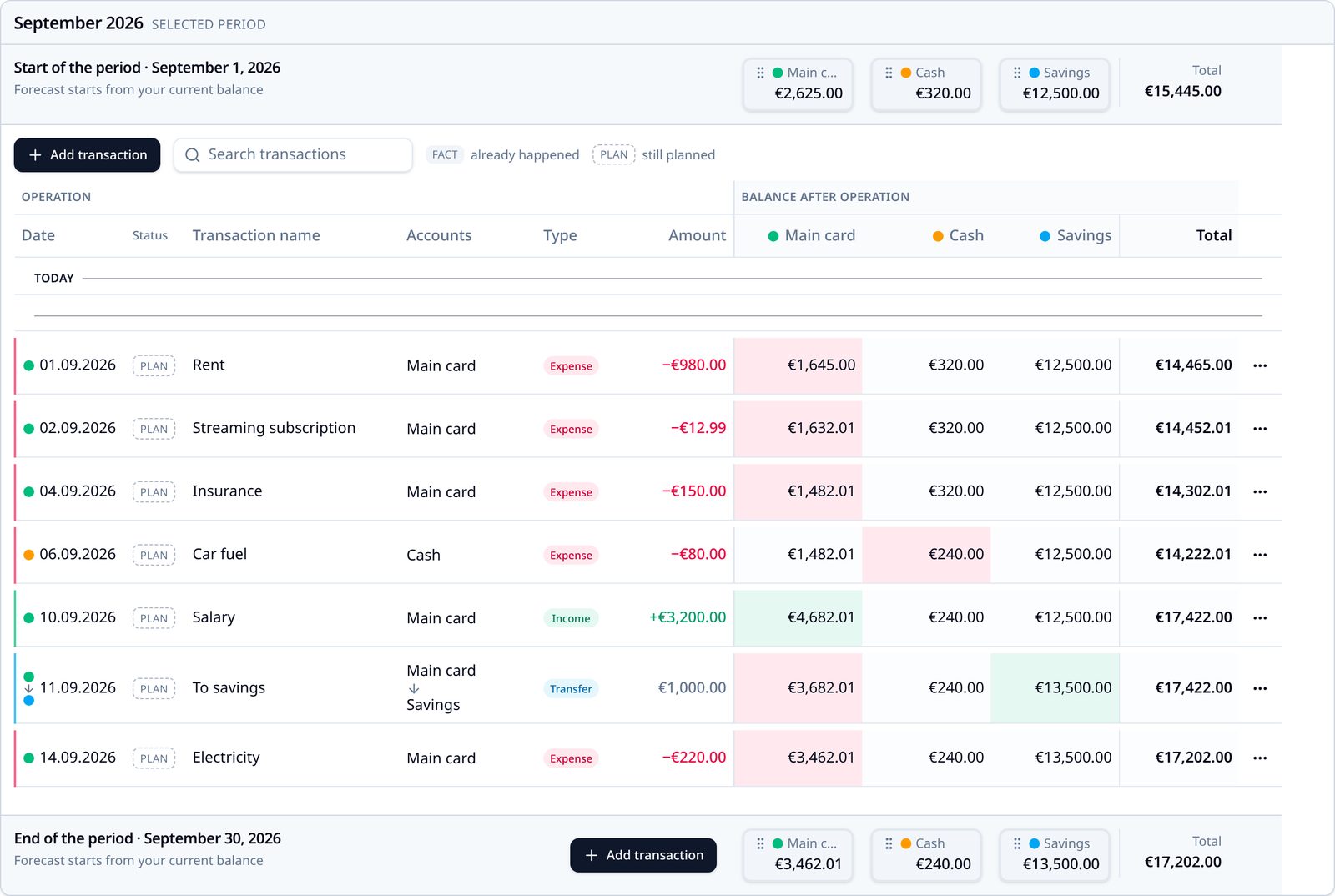
The table shows each day of the period and the balance every account will hold on it.
Check the Year Overview
Twelve months at a glance: which months end short, and which end with spare cash.
Act on the forecast
Move money, postpone a payment or change an amount — the forecast updates immediately.
Confirm what really happened
When money actually moves, mark the transaction as fact; plan and reality stay side by side.
Learn about budgeting
Short, practical guides. Start wherever your own question is.
- Personal cash flow forecast: see your future balance
- How to avoid a negative balance before it happens
- How to Create a Personal Budget (Step-by-Step)Build a budget in an evening: real take-home income, fixed costs with their dates, and a remainder that has a job.
- Monthly Budget Template: A Simple Way to Plan Your MoneyA five-block template with worked example figures, and why writing the payment dates matters as much as the amounts.
- How to Stop Overspending: Practical Fixes That WorkFind out whether your leak is many small purchases or a few large ones, then change the defaults instead of relying on willpower.
- How Much Money Should You Save Each Month?Saving in stages — starter buffer, expensive debt, emergency fund, goals — and what to do when 20% is out of reach.
- Budgeting for Couples: Systems That Actually HoldJoint, separate or hybrid accounts, splitting fairly when incomes differ, and a fifteen-minute monthly check-in.
- How to Budget With Irregular IncomePay yourself a baseline salary from a buffer account, take tax off the top, and plan on the dates clients really pay.
- 50/30/20 Budget Rule: How It Works and When It Doesn'tThe split explained with real numbers, the three situations where it breaks, and sensible variations to use instead.
- How to Plan for Big Expenses Without Breaking Your BudgetList the twelve-month costs, turn each into a monthly slice, and spot the month where three of them collide.
Frequently asked questions
- What is cash flow planning?
- Cash flow planning starts with your current account balances and adds the money you expect to receive and spend in the future, so you can see how your balance changes over time instead of only reviewing past spending.
- How is cash flow planning different from budgeting?
- Budgeting answers how much you should spend. Cash flow planning answers when the money will actually be there. Cash Flow Planner focuses on the second question.
- Can I plan recurring income and expenses?
- Yes. Salary, rent, subscriptions, insurance, utilities and regular transfers can be planned once as recurring transactions and are projected forward across the next 12 months.
- What is the difference between FACT and PLAN?
- A planned transaction is money you expect to move; a fact is money that already moved. Both are included in the balance, but only past and current dates can be marked as fact, so the forecast never pretends the future has already happened.
- How is this different from looking at my bank account?
- Your bank shows the balance you have now, after the fact. Cash Flow Planner shows the balance you will have on any future day, across all of your accounts together, once the rent, salary, subscriptions and one-off payments you already know about are taken into account.